
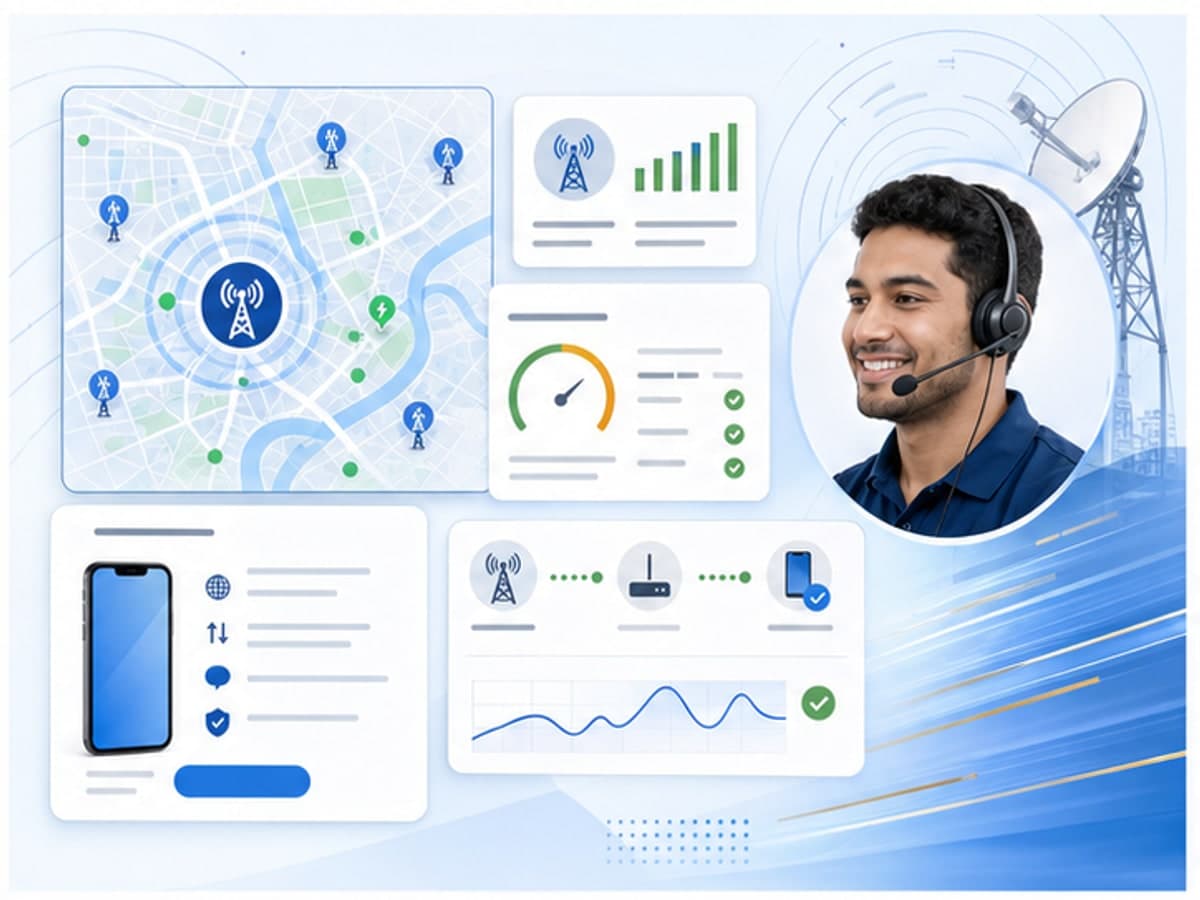
How telecom and ISP operators use outsourced call centers for tier-1 technical support, billing care, retention desks, and install coordination — at the volumes and hours telecom demands.
Telecom support: huge volume, thin margins, impatient customers
Telecom operators run some of the largest support volumes in any industry: connectivity is essential, outages are emotional, billing is complex, and competitors advertise switching deals during every hold. The operational problem is scale with quality — millions of routine contacts that must be cheap, wrapped around retention and escalation moments that must be excellent. That split is exactly what a well-designed outsourcing program industrializes.
The core telecom programs
Tier-1 technical support
Modem reboots, provisioning checks, outage verification, speed troubleshooting, device setup — high-volume, runbook-driven work where agents resolve documented issues and escalate genuine network problems with diagnostics attached. Strong knowledge-base discipline and live network-status visibility separate good tier-1 desks from frustration loops.
Billing and account care
Plan explanations, proration questions, promo roll-offs, payment arrangements, plan changes. Billing confusion is a top churn driver in telecom — a patient, accurate billing desk is retention infrastructure, not a cost center.
Retention and save desks
Cancellation intent calls routed to specifically trained save teams with defined offer matrices. These are negotiation conversations that decide lifetime value in minutes — see our take on why they stay human in AI vs human call centers.
Install, activation and dispatch coordination
Appointment scheduling, pre-install confirmation, day-of coordination, and post-install follow-up — the workflow where a missed appointment costs a truck roll and a first impression simultaneously.
Outage surge response
When the network hiccups, volume explodes in minutes. Providers with surge capacity, prepared outage scripting, and proactive status messaging turn a bad network day into a managed communication event rather than a service collapse.

What to demand from a telecom program
- OSS/BSS integration: agents working live in your provisioning, ticketing, and billing systems — not alongside them.
- 24/7 coverage economics: connectivity problems keep no business hours; blended delivery models make round-the-clock coverage affordable.
- Escalation with diagnostics: tier-2 should receive line tests and steps attempted, not a bare transfer.
- Metrics split by intent: resolution rate on tech support, save rate on retention, first-contact resolution on billing — blended averages hide exactly the failures that drive churn.
Global Empire Corporation runs telecom support programs across tier-1 technical, billing care, retention, and install coordination — with the surge capacity outage days demand. Explore our telecommunications BPO services and technical support outsourcing, or request a proposal.
Churn is the number every telecom programme is actually about
Telecom support economics are dominated by one fact: the product is a subscription in a market where switching is easy and constantly advertised. Every support contact is therefore a retention event whether it is labelled one or not — a billing surprise handled badly is how a customer starts comparing competitors, and an outage call that goes nowhere is the push that makes them act. Programmes measured only on handle time and answer speed reliably optimise into higher churn, because the fastest way through a hard call is rarely the one that saves the customer.
The contacts that decide churn cluster in three places. Billing disputes: the customer believes they are being overcharged, and the resolution has to be explainable, not just processed — an agent who can walk through the bill line by line saves accounts a credit alone would not. Service degradation: intermittent faults generate repeat contacts, and it is the third unresolved call, not the first, that loses the account, which makes repeat-contact tracking on the same fault a core metric rather than a nice-to-have. And contract endings: the weeks around a contract expiry are when support quality converts directly into renewal or loss, so those callers deserve routing to the strongest agents, not the general queue.
Technical support adds its own discipline: structured diagnosis before dispatch, because a truck roll is one of the most expensive outcomes a call can have, and a programme that resolves ten per cent more faults remotely pays for itself in avoided dispatches alone. The right scorecard for a telecom programme reads: save rate on at-risk contacts, repeat-contact rate per fault, remote resolution rate, and only then the queue statistics everyone else leads with.
Frequently asked questions
What telecom support functions are typically outsourced?
Tier-1 technical support, billing and account care, retention and save desks, install and dispatch coordination, activation support, and outage surge response — with tier-2/3 network engineering usually retained in-house.
How do outsourced agents handle technical troubleshooting?
Through runbook-driven diagnostics against your knowledge base with live network-status and provisioning visibility, resolving documented issues at tier-1 and escalating genuine network problems with diagnostics attached.
Can retention calls be outsourced effectively?
Yes, when routed to dedicated save teams with negotiation training and a defined offer matrix. Save desks are specialist sales operations, and measured save rates make performance transparent.
How do providers handle outage volume spikes?
Surge staffing agreements, pre-approved outage scripts, IVR and proactive status messaging to deflect duplicate contacts, and queue prioritization — planned in advance, not improvised during the event.
What metrics matter most in telecom support?
By intent: first-contact resolution and repeat-contact rate on technical calls, save rate on retention, billing-dispute resolution time, truck-roll avoidance from remote resolution, and speed to answer during outage events.
By industry
Keep reading
The rest of this cluster, for the question you are actually working through.
- Financial Services Call Center Outsourcing: A Compliance-First Guide
- Ecommerce Customer Service Outsourcing: Peaks, Channels and Returns
- Hospitality Call Center Outsourcing: Reservations, Guests and Peak Demand
- Legal Call Center Outsourcing: Intake, Confidentiality and After-Hours Coverage
- Manufacturing Call Center Outsourcing: Order Desk, Dealer Support and Warranty Lines
- Retail Call Center Outsourcing: Peak Season, WISMO and Returns Done Right
- Healthcare Customer Support Outsourcing: Patient Access Without the Compliance Risk