
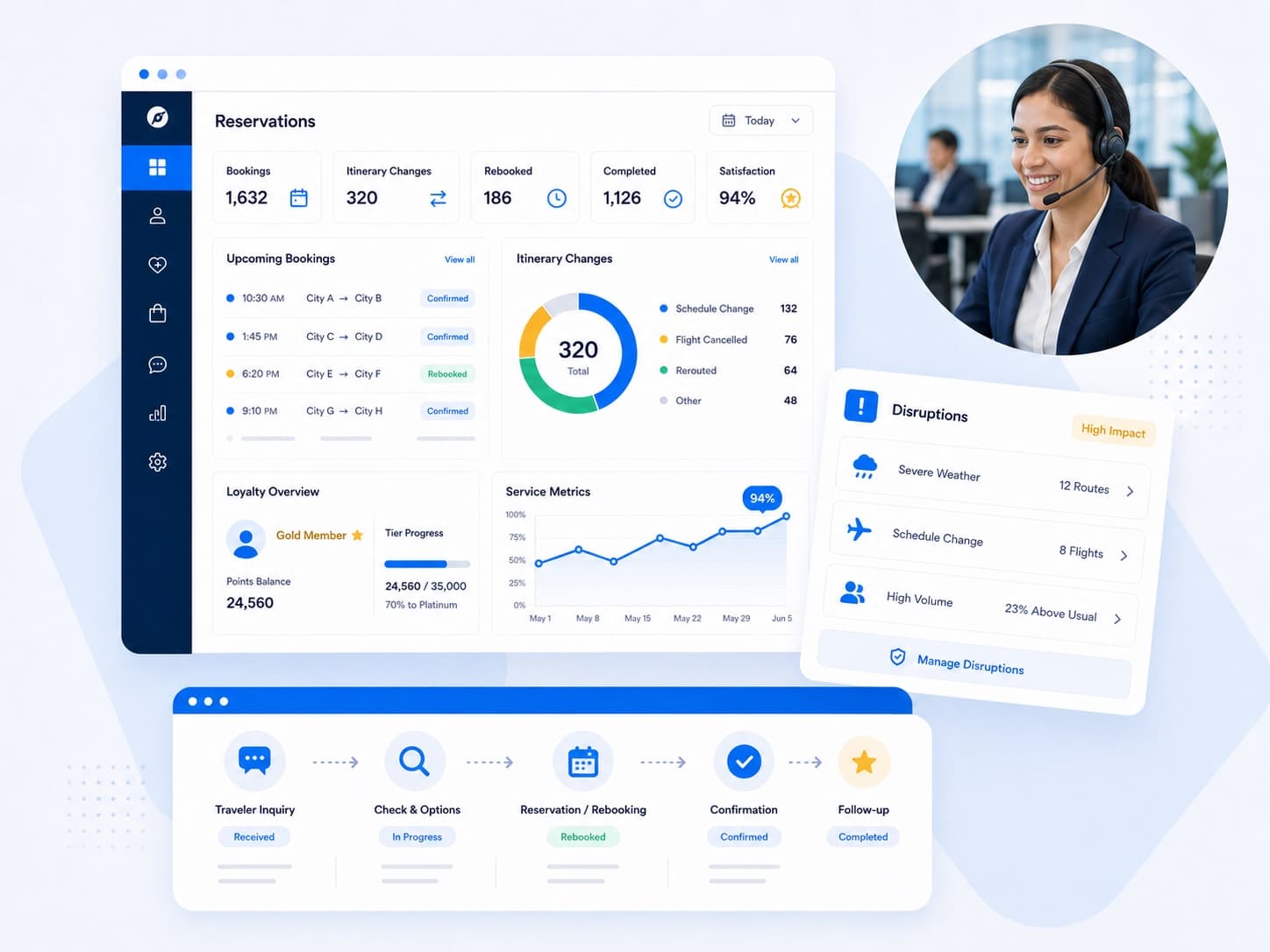
How outsourced reservation and guest support works for hotels, travel and hospitality operators — handling seasonal peaks, disruption events, multilingual demand, and revenue-bearing calls.
In hospitality, the call is the transaction
In most sectors a support call costs money. In hospitality a reservation call is revenue — an unanswered one is a booking that went to a competitor or an OTA, taking its commission with it. That changes how the operation should be staffed and measured.
It also means abandonment rate is not a service metric here. It is a revenue metric, and it is usually worth more than the cost of answering.
The demand pattern
Hospitality demand is volatile in ways that are hard to staff internally:
- Seasonal peaks that can run several times baseline for a defined period
- Booking windows concentrated into evenings and weekends, when travellers plan
- Disruption events — weather, cancellations, closures — that generate enormous unplanned volume with no notice
- Round-the-clock demand from guests already travelling, in other time zones
- Multilingual demand that varies by season and source market
Staffing internally for the peak is uneconomic; staffing for the average fails during exactly the periods that generate the most revenue. Outsourced capacity that flexes solves a real problem here rather than a theoretical one.

What outsourced hospitality teams handle
- Reservations — new bookings, modifications, cancellations, and group enquiries
- Guest services — pre-arrival questions, special requests, and in-stay support
- Overflow and after-hours, so the front desk is not choosing between the guest present and the phone ringing
- Disruption response — rebooking and rerouting during weather or operational events
- Loyalty program support — enrolment, points, and tier questions
- Post-stay follow-up — feedback, billing queries, and recovery after a complaint
Front desk versus contact center
Many properties still route calls to the front desk, which forces staff to choose between the guest standing in front of them and the phone. Both experiences suffer. Moving reservation and enquiry calls to a dedicated team usually improves the on-property experience as much as the phone one.
Selling, not just answering
Reservation agents are salespeople. They should be able to describe room types and properties accurately, handle rate objections, offer alternatives when the requested dates are unavailable, and upsell appropriately. An agent who responds to "you're sold out" with an apology rather than an alternative has lost a booking that was available to save.
This means training on your inventory and rate structure, not just call handling — and measuring conversion, not only speed of answer.
Systems and multilingual coverage
Agents need live access to your property management or reservation system so availability, rates, and guest history are accurate in the moment. Quoting from stale data produces overbookings and disputes at check-in.
Multilingual coverage is a genuine revenue lever in hospitality, where source markets shift by season. A provider with multiple delivery locations can supply seasonal language coverage that would be impractical to hire for directly.
Metrics that reflect revenue
- Abandonment rate — every abandoned call is a potential lost booking
- Conversion rate — enquiries that become confirmed reservations
- Average booking value and upsell attachment
- Speed of answer during peak windows specifically, not blended across the week
- Direct booking share versus OTA — the number that shows whether the program is protecting margin
- Guest satisfaction on contacts handled off-property
Sizing the opportunity before you buy
Hospitality is one of the few sectors where the value of answering can be estimated with reasonable confidence before a program starts, because the missed contact has a knowable value.
The calculation is straightforward: take abandoned and unanswered calls over a representative period, apply your historical enquiry-to-booking conversion rate, and multiply by average booking value. Then adjust for two things buyers routinely get wrong. First, abandoned calls convert at a somewhat different rate than answered ones — callers who abandon after a long wait were often high-intent, which argues against discounting them heavily. Second, a share would have called back; your own repeat-call data will indicate roughly what share, and only the remainder is genuinely lost.
Run the same calculation separately for peak windows. The blended figure understates the case badly, because abandonment clusters precisely in the hours when booking intent is highest, so the lost revenue is concentrated rather than spread evenly across the week.
The direct booking argument
Every reservation that moves from a phone call to an online travel agency carries a commission for the life of that booking, and often the guest relationship with it — contact details, preferences and the ability to market to them directly. A phone program that captures bookings which would otherwise route through an intermediary is not only protecting a transaction; it is protecting margin and a relationship.
This reframes how the program should be justified internally. Compared against the cost of answering, a reservations team looks like a service expense. Compared against distribution cost on the bookings it captures directly, it frequently looks like the cheapest acquisition channel the property operates.
It also changes what to measure. Direct booking share is the number that demonstrates the argument, and it should be tracked from the baseline rather than reconstructed later.
Disruption is the real test
Any provider can handle a Tuesday. Hospitality programs are judged on the days when weather, an operational failure or a closure generates many times normal volume with no notice, and every caller is already unhappy.
What separates providers on those days is preparation rather than capacity:
- A pre-agreed surge protocol — who is called in, from which other programs, within what timeframe. Agreed in writing before the season, not negotiated during an event.
- Authority boundaries set in advance. What the team may waive, rebook, comp or refund without escalation. Without these, a disruption becomes a queue of escalations to a property team already overwhelmed.
- Pre-written scenario guidance for the disruptions your property actually faces, so agents are not improvising policy during the worst hour of the month.
- A defined channel to your operations team for live information. Nothing damages a guest relationship faster than a confident answer that turns out to be wrong.
- Callback capability, so guests are not held in a queue during an event that will take hours to resolve.
Ask any prospective provider to describe the last disruption event they handled and what they changed afterwards. The specificity of the answer is the whole evaluation.
Group, event and extended-stay enquiries
Most hospitality outsourcing discussions assume transient leisure bookings, but group and event enquiries have a different economic profile and are often handled worst. A single group enquiry can be worth many individual bookings, arrives with a longer decision cycle, and requires quoting judgment rather than availability lookup.
Decide deliberately whether these route to the outsourced team or straight to a sales contact. The common failure is routing them by default into a queue optimised for fast transactional handling, where a high-value enquiry receives a two-minute conversation appropriate to a one-night booking. If the outsourced team is to handle them, they need qualification criteria, a quoting boundary and a defined handoff — the same specification discipline any sales program requires.
Protecting the brand voice off-property
Hospitality brands invest heavily in a service standard that is expressed in person, and the phone is where it is most easily lost. The mechanisms that keep it intact are unglamorous and effective: property familiarisation for the agents who will represent it, including imagery and a walkthrough of what a guest actually sees; a written voice guide with real examples of the phrasing you want and the phrasing you do not; and calibration sessions where property leadership scores recorded calls alongside the provider's quality team.
That last practice matters more than any contractual quality clause. A property manager who has scored twenty calls understands the program, and the provider learns the standard from the people who hold it rather than from a document.
Multi-property and brand-standard programs
A single property outsourcing its overflow is a straightforward program. A group running several properties — or a brand supporting franchisees — faces a harder design question: how much should be standardised, and how much must stay local.
What genuinely benefits from being centralised is the operating layer: one reservation team pooling demand across properties smooths the volatility that makes each property individually uneconomic to staff, and a caller who wants a city rather than a specific hotel can be sold the group's whole inventory instead of one property's availability. That last point is frequently the strongest commercial argument for centralising and the one most often left out of the business case.
What must stay local is the knowledge that makes an answer trustworthy: which rooms genuinely have the view, how long the walk to the conference centre actually takes, what the parking situation is during an event. Centralised teams that lack this produce confident, plausible, wrong answers, and those are more damaging than an honest transfer to the property.
The workable structure is a central team with property-specific knowledge content maintained by each property, an explicit boundary on what the central team will answer versus route, and a fast path to the property for anything beyond it. The boundary should be written and reviewed, because it drifts — central teams accumulate confidence faster than they accumulate knowledge.
Seasonality and the contract
Hospitality demand swings further than almost any other sector's, and a contract written for the average will fail at both ends of the year. Two mechanisms matter more here than anywhere else.
The first is a ramp schedule agreed against your season rather than against a notice period. A provider that needs a fixed lead time to add capacity is a provider you must forecast for months ahead — workable if the season is predictable, dangerous if your demand responds to weather or events. Agree the trigger, the lead time and the cost before the season, and revisit it after each one.
The second is how the quiet months are priced. Minimums written to make peak pricing attractive can make the off-season expensive enough to erase the gain. Model the full annual cycle, not the peak, and compare providers on the year rather than on the quarter that flatters them.
Track speed of answer during peaks separately. A blended weekly average can look healthy while the specific evening hours that carry most booking demand are failing.
Frequently asked questions
Why outsource hospitality reservations rather than use the front desk?
Front desk staff must choose between the guest in front of them and the ringing phone, and both experiences suffer. A dedicated team usually improves the on-property experience as much as the phone one.
How do outsourced teams handle seasonal peaks?
Providers flex capacity into your peak and back out afterwards, because your quiet season is another client's busy one. That is uneconomic to replicate with internal hiring.
Can outsourced agents sell, not just take bookings?
They should. Reservation agents need training on your inventory and rate structure so they can offer alternatives when requested dates are unavailable and upsell appropriately — and be measured on conversion, not just speed of answer.
What system access do reservation agents need?
Live access to your property management or reservation system. Quoting availability and rates from stale data produces overbookings and disputes at check-in.
Which metric matters most in hospitality?
Abandonment rate, because an abandoned reservation call is usually a booking lost to a competitor or an OTA. Track speed of answer during peak booking windows separately rather than blended across the week.
By industry
Keep reading
The rest of this cluster, for the question you are actually working through.
- Financial Services Call Center Outsourcing: A Compliance-First Guide
- Ecommerce Customer Service Outsourcing: Peaks, Channels and Returns
- Legal Call Center Outsourcing: Intake, Confidentiality and After-Hours Coverage
- Manufacturing Call Center Outsourcing: Order Desk, Dealer Support and Warranty Lines
- Retail Call Center Outsourcing: Peak Season, WISMO and Returns Done Right
- Healthcare Customer Support Outsourcing: Patient Access Without the Compliance Risk
- Telecom Call Center Outsourcing: Churn, Tier-1 Tech Support and Billing at Volume
Related
Air travel needs two specialist scopes beyond general hospitality support: passenger-facing airline customer service and operational aviation support for airports, ground handling, MRO and cargo.