

Why Back Office Work Is Different
Back office is the only outsourced function where nobody is watching the work happen. A bad call is heard, a bad email is read, a bad chat is screenshotted. A mis-keyed claim number is silent — it passes validation, sits in a system, and surfaces weeks later as a rejected payment, a failed reconciliation or a compliance finding, by which point the connection back to a data entry made in March is gone.
That invisibility changes what a buyer should compare. There is no customer satisfaction score to fall back on and no recording to review, so the whole assessment rests on measured accuracy, documented process and audit trail. The providers below are ranked on those, and on the one thing that decides more back office engagements than any other: whether your process was ever written down.

What Back Office Outsourcing Has to Get Right
Most failed back office transitions fail before anyone starts working, because a process that lives in three people's heads cannot be handed to anyone. The discovery and documentation phase is the part buyers most often compress to save time, and it is the part that determines whether the first six months are production or archaeology.
The second thing that decides it is what accuracy actually means. Ninety-nine percent sounds excellent and is a thousand errors in a hundred thousand transactions, which for invoicing or claims is not a rounding difference.
- A real discovery phase that documents the process as it is performed, not as the manual describes it
- Accuracy measured on outcomes rather than on a sampled review, and stated per transaction type
- Maker-checker or four-eyes controls on anything financial, with segregation of duties enforced
- Turnaround times set per transaction type, because a claim and an address change are not the same job
- An audit trail that identifies who processed what and when, retained long enough to answer an auditor
- Data security proportionate to what is being handled — payroll, medical records and bank details, with no customer on the line to notice a lapse
- An honest view of what should be automated rather than staffed, and willingness to say so
- Peak-cycle capacity for month-end, quarter-end and season, which is when errors cluster
Explore our back office services
How We Ranked These Back Office Companies
To build this ranking we weighted the criteria that predict success in back office specifically, rather than the generic measures used to compare providers by size:
Cost per transaction is the obvious comparison and the one most likely to mislead. Back office errors are rarely paid for by the department that caused them — they surface downstream as rework, write-offs, failed audits and delayed close — so a provider can post the lowest unit cost on the shortlist while being the most expensive to have used. We weighted accuracy, controls and transition rigor above unit price throughout.
- Measured accuracy and quality control method
- Process documentation and transition discipline
- Controls: segregation of duties, maker-checker, audit trail
- Security posture for sensitive data at rest and in transit
- Turnaround performance against per-transaction service levels
- Automation capability and honesty about where it belongs
- Peak-cycle elasticity
- Systems integration and reporting depth
Top Back Office Companies Comparison Chart
How the leading back office outsourcing companies compare on focus and strengths. Ordered by the balance of process capability and program flexibility, not by headcount.
| Company | Best For |
|---|---|
| Global Empire Corporation | Mid-market & regulated industries |
| Intelemark | B2B appointment setting |
| Call Motivated Sellers | Real estate seller outreach |
| Customer Communications Corp | Brand-aligned omnichannel support |
| Call Center Staffing | Surge staffing & flexibility |
| B2B Appointment Setting | SMB pipeline building |
| Contact Center USA | US-only onshore delivery |
| Call Center Communications | Canadian near-shore delivery |
| Business Process Outsourcing | High-volume enterprise CX |
| Canada Contact Centre | Canadian enterprise & bilingual programs |
| B2B Telemarketing | Tech-enabled voice programs |
| Telemarketing Services | Automation-supported outbound |
| Appointment Setting | Regulated appointment programs |
| Teleperformance | Global enterprise scale |
| Concentrix | Automation-heavy enterprise CX |
Global Empire Corporation
Headquarters: United States
Website: www.globalempire.com

Full inbound and outbound operations — customer care, technical support, sales, and lead generation — built around each client's compliance requirements and growth plan.
Intelemark
Headquarters: United States
Website: www.intelemark.com
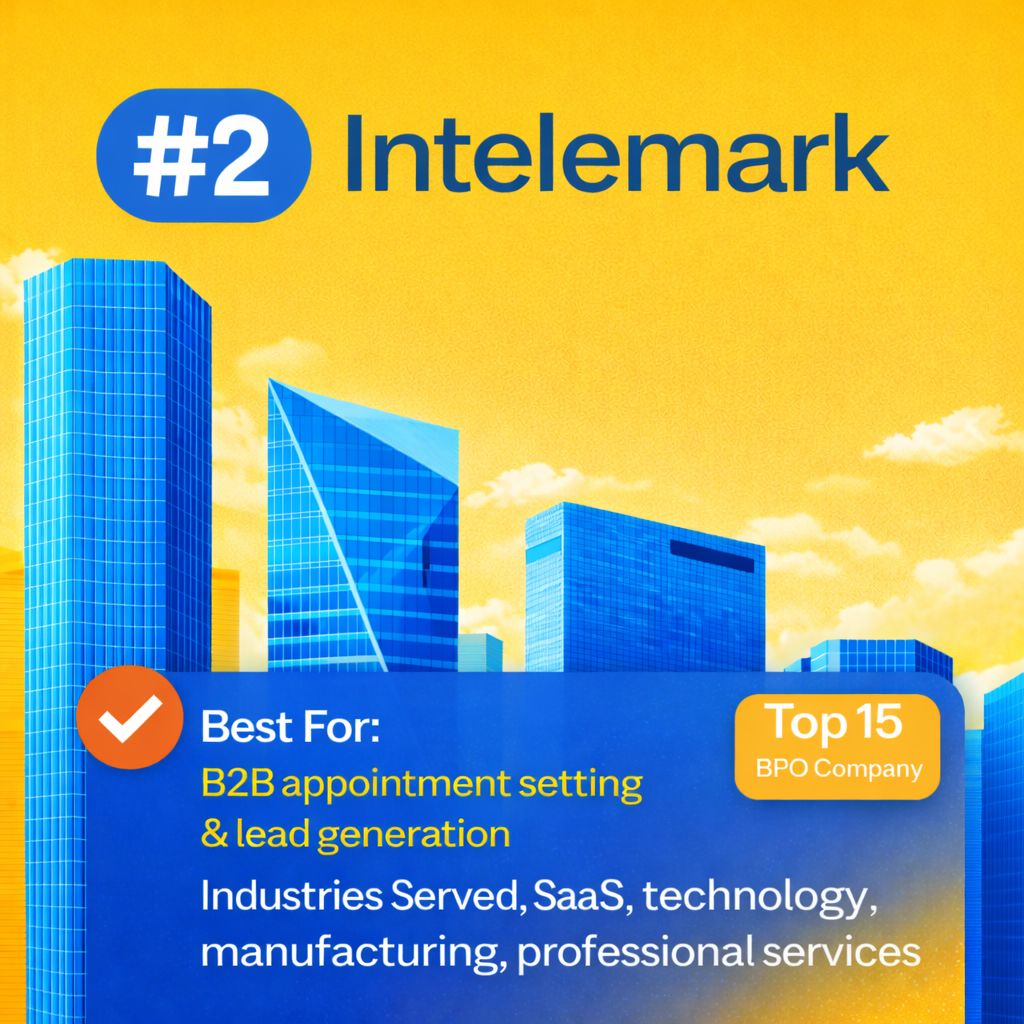
Consultative outbound calling for complex B2B sales cycles, where prospects expect an informed conversation rather than a scripted dial.
Call Motivated Sellers
Headquarters: United States
Website: callmotivatedsellers.com

Specialized outbound campaigns that identify and qualify motivated property sellers for real estate investors and acquisition teams.
Choosing the Right Back Office Partner
The right back office partner depends on how well documented your process already is. If it is genuinely mapped, you can move quickly and choose largely on accuracy, controls and price. If it is not — and it usually is not — the thing you are actually buying first is the discovery work, and the provider best at that is rarely the cheapest per transaction.
Ask how accuracy is measured and on what sample size, ask to see a redacted process document from a comparable transition, and ask what the provider has told a client not to outsource. That last question is unusually diagnostic: a provider that has never advised against a scope is selling capacity rather than judgment.
Global Empire Corporation runs back office operations against documented process and measured accuracy, with the controls and audit trail that regulated work requires and honest guidance on what belongs in automation instead.
Treat this as a shortlist rather than a decision. Put the same scenarios to every provider you talk to, ask for the numbers behind the claims, and run a defined pilot with agreed service levels before committing volume.
Frequently asked questions
What does a back office outsourcing company do?
It takes on the administrative and transactional work behind your operation rather than the customer-facing part — data entry and validation, order and invoice processing, claims handling, document management and digitization, reconciliations, payroll and HR administration, and reporting. The work is measured on accuracy and turnaround rather than on satisfaction, because the person affected by it is usually not on the phone.
What accuracy rate should we expect?
Ask for it per transaction type, with the measurement method attached, rather than as a headline. The method matters more than the number: accuracy verified by re-processing a random sample means something, accuracy from an agent's own review means very little, and accuracy calculated on fields rather than on records can turn a wrong record into a 95 percent score. Then translate the percentage into absolute errors at your volume, which is the figure your finance team will actually feel.
How long does transition take?
For a documented, stable process, four to eight weeks through discovery, documentation, parallel running and cutover. For an undocumented one, longer — and the extra time is spent writing down what your team does, which is work that has to happen whether or not you outsource. Be cautious of a provider willing to skip the parallel run; running both in step is what surfaces the exceptions nobody mentioned.
Is our data safe with a back office provider?
It is the question to press hardest here, because back office handles your most sensitive material with no customer present to notice a lapse. Establish where data is physically processed and stored, whether agents work in a controlled environment with removable media and personal devices restricted, how access is scoped and revoked, what is encrypted at rest, and when the provider was last independently audited. Ask for the certifications and then ask for the most recent report.
Should we automate this work instead of outsourcing it?
Often partly. Structured, high-volume, rule-based steps are usually better automated than staffed, and a good provider will tell you which of yours qualify even though automating them shrinks the contract. Exceptions, judgment calls and anything requiring interpretation still need people. The strongest arrangements are a blend, and the useful question in a sales conversation is which parts of our process would you automate rather than staff.
How is back office outsourcing charged?
Two common structures. A dedicated FTE model gives you a named team and predictable capacity, and suits variable or judgment-heavy work. A transaction model ties cost to output and suits stable, well-defined volume. Transaction pricing needs a precise definition of what counts as one transaction and what happens to exceptions, or the difficult items quietly become out of scope. Cost is driven mainly by volume, complexity per item, turnaround requirements and the control regime.
How do we keep control of a process we no longer perform?
Through reporting and retained knowledge rather than supervision. Keep the process documentation as your asset and require it to be updated as procedures change, insist on exception reporting rather than only volume and accuracy summaries, and keep at least one person internally who genuinely understands the work end to end. Organizations that lose control usually lost the documentation and the internal expertise first, and only discovered it when they tried to change provider.
Rankings for other service lines
The same fifteen providers, scored on what each service line actually demands.
- Telemarketing
- Appointment Setting
- Lead Generation
- Live Chat Support
- Technical Support
- Email Support
- Answering Service
- Hotel BPO
- Rideshare Support
- Delivery Support
- Food Delivery Support
- Restaurant Support
- Fintech Support
- Mortgage Support
- Pharmaceutical Support
- iGaming Support
- Subscription Support
- Virtual Receptionist
- Medical Answering Service
- Legal Answering Service